
AI | Artificial Intelligence | NC State ISE

AI | Artificial Intelligence
Last Updated: 03/27/2025 | All information is accurate and still up-to-date
AI is revolutionizing industrial and systems engineering, and you can be at the forefront of this transformation. In the ISE Department, we explore cutting-edge AI applications, integrating them into real-world operations for smarter decision-making and greater efficiency. Our curriculum empowers you to master AI-driven innovations and unlock endless career possibilities. You will learn how to apply AI in real-world situations. Courses cover topics like machine learning, data science and automation. Through hands-on projects, you will develop skills that prepare you for the future.
AI’s Impact on Industrial and Systems Engineering
AI is transforming industrial and systems engineering. It helps businesses improve efficiency, reduce costs and make smarter decisions. Industrial and system engineers use AI to analyze data, automate processes and predict future trends. As a result, companies can work faster and more accurately.
One major impact of AI is automation. Many industries now use AI-powered robots and machines to handle repetitive tasks. This change allows engineers to focus on problem-solving and innovation. Additionally, AI improves quality control by quickly detecting errors and defects in production lines.
Another benefit of AI is data analysis. Engineers rely on AI to process large amounts of information in seconds. With this ability, they can identify patterns, optimize supply chains, and enhance decision-making. Because of AI, businesses can respond faster to market demands.
AI will continue shaping the field of industrial and systems engineering. By embracing these advancements, engineers can solve complex problems and drive innovation. With AI, the future of engineering looks brighter than ever.
AI Courses
- COMING SOON
Faculty Research
Faculty members research and teach AI methodologies and applications. Each faculty member integrates AI into research, education and real-world use. Their work drives progress in optimization, healthcare analytics, intelligent manufacturing and supply chain systems. You can explore their contributions to see how AI is shaping the future of engineering.
AI Methodology
Adolfo Escobedo

Adolfo R. Escobedo applies AI to sustainable infrastructure and decision support tools for human-in-the-loop systems. He develops data-driven methods to reduce landfill waste and strengthen the electric grid against emergencies and environmental stress.
He also uses machine learning to improve the quality of human inputs in complex decision-making tasks. In addition, his work in optimization algorithms enhances the reliability of mathematical programming software, a key tool for AI and machine learning.
Discover more about Escobedo’s ResearchShu-Cherng Fang

Shu-Cherng Fang studies mathematical optimization, computational intelligence and AI in industrial engineering and operations research. He applies advanced optimization theory, fuzzy logic and neural networks to solve complex decision-making problems. His work helps businesses and industries make smarter choices using AI.
He also improves support vector machine and support vector regression models for machine learning under uncertainty. These advancements strengthen AI-powered, data-driven decision-making. In addition, his research supports innovation in resource allocation, operations management and smart logistics. Most importantly, he develops flexible decision-making systems that help industries adapt and grow.
Discover more about Fang’s ResearchXiaolei Fang

Xiaolei Fang researches AI-driven methods like statistical learning, deep learning and optimization to analyze large-scale industrial data. His work improves energy, manufacturing and service industries by solving challenges in efficiency, scalability and data privacy.
He applies AI to real-time system monitoring, anomaly detection and failure prediction. By combining machine learning and optimization, he develops scalable AI solutions that improve reliability and decision-making in complex industrial systems.
Discover more about Fang’s ResearchYahya Fathi

Yahya Fathi studies how AI interacts with different types of programming and optimization methods. His research applies AI to data mining, cluster analysis, database management, and production planning.
His work helps industries plan better and respond to challenges more effectively. He also uses AI to improve disaster response planning and emergency logistics.
In addition, he develops intelligent decision-support systems that boost efficiency. His expertise in AI-powered predictive modeling helps transportation agencies, furniture manufacturers, and supply chains allocate resources, reduce risks, and optimize operations.
Discover more about Fathi’s ResearchOsman Ozaltin

Osman Ozaltin uses AI and healthcare analytics to improve medical decision-making and hospital operations. He develops machine learning models for risk assessment, patient diagnosis and treatment planning. His AI-driven methods help health systems work more efficiently while improving patient care.
His research also expands AI in public health and disease modeling. He uses predictive analytics and mathematical models to strengthen data-driven decision-making in complex healthcare systems. Most importantly, his work enhances healthcare access, resource distribution and treatment success.
Discover more about Ozaltin’s ResearchSara Shashaani

Sara Shashaani creates autonomous decision-support tools to improve complex systems and large-scale industrial operations. She uses predictive and prescriptive analytics to optimize efficiency and performance.
She specializes in Monte Carlo sampling methods, applying them to probabilistic prediction, bias correction, and feature selection. Her algorithms enhance the speed and reliability of stochastic optimization.
One key focus is calibrating Digital Twins, which helps industries make real-time decisions. She applies this technology to wind energy and additive manufacturing, allowing businesses to adapt to changing conditions and improve operations.
Discover more about Shashaani’s ResearchHong Wan

Hong Wan applies AI to healthcare logistics, supply chain analytics and smart manufacturing. She uses machine learning to improve predictive maintenance, demand forecasting and operational efficiency in complex industries. Her research helps businesses and healthcare systems run more smoothly and make better decisions.
She also creates AI-powered solutions to strengthen supply chains and optimize production scheduling. In addition, she develops automated quality control methods that improve product reliability. Her work enhances infrastructure sustainability by integrating advanced data analytics with smart decision-making models. Most importantly, her research supports efficient and adaptable operations in modern industries and healthcare systems.
Discover more about Wan’s ResearchAI Applications
Karen Chen

Karen Chen researches human-centered system interfaces and interactions using augmented reality and virtual reality with support from AI. She develops AI-driven extended reality technologies to improve user experiences and interactions in digital environments.
Her work also enhances workforce training simulations and immersive learning environments. By integrating AI, she creates realistic and adaptive training tools that help users develop skills more effectively.
Discover more about Chen’s ResearchJingyan Dong

Jingyan Dong uses deep learning, AI-enhanced automation and digital twin technologies to improve precision manufacturing and smart production. His research helps industries optimize process control and increase efficiency.
He also develops AI-powered systems for defect detection and predictive maintenance. In addition, he creates intelligent quality control methods that improve production accuracy. Most importantly, his work ensures data-driven decision-making in industrial engineering.
Discover more about Dong’s ResearchLeila Hajijbabai

Leila Hajibabai focuses on AI-powered transportation systems, urban mobility optimization and smart logistics. She develops machine learning-based traffic management models and sustainable freight planning tools.
Her research also creates AI-enhanced last-mile delivery strategies. Through her work, she advances autonomous transportation, equitable urban planning and AI-driven network optimization.
Discover more about Hajibabai’s ResearchOla Harrysson

Ola Harrysson’s research focuses on AI-enhanced additive manufacturing and biomedical 3D printing. He uses AI to improve material properties and production accuracy. His work also streamlines the design-to-manufacturing process.
He integrates machine learning algorithms for process monitoring, defect detection and quality assurance in metal and polymer manufacturing. In biomedical applications, his research improves patient-specific implants, prosthetics and orthopedic devices. This ensures better customization and performance.
His contributions help advance smart manufacturing and drive innovations in medical devices.
Discover more about Harrysson’s ResearchMohammad Hosseinian

Mohammad Hosseinian studies how decision-making affects cancer treatment. He uses AI and machine learning to create predictive models that assess treatment-related toxicities.
By analyzing patient data, he designs personalized treatment plans that improve patient care. His work helps doctors make better decisions and reduce harmful side effects.
Discover more about Hosseinian’s ResearchJordan Kern

Jordan Kern uses AI-driven predictive analytics to improve electric power systems in both long-term planning and real-time operations. AI helps predict electricity supply and demand under different weather conditions, leading to better decision-making.
With improved predictions, system operators can optimize new power infrastructure and control plants more efficiently. These improvements increase system reliability and lower costs for consumers. His team also uses AI to detect patterns linked to power system failures when supply can’t meet demand.
By analyzing weather conditions, AI helps identify risks and assess the power grid’s vulnerability to deliberate attacks.
Discover more about Kern’s ResearchYuan-Shin Lee

Yuan-Shin Lee develops AI-powered robotics and smart production automation to improve efficiency in modern industrial systems. His research combines machine learning, computer vision and advanced control algorithms to optimize manufacturing.
He uses AI-driven techniques to enhance real-time process monitoring, adaptive manufacturing and robotic precision. His work also improves intelligent machining and cyber-physical production systems.
Additionally, his contributions include digital twin technology, AI-assisted product design and sustainable manufacturing solutions. These advancements make industrial operations smarter, more resilient and highly efficient.
Discover more about Lee’s ResearchFred Livingston

Fred Livingston focuses on AI-powered energy optimization and smart grid analytics. His research uses machine learning to improve power system resilience and boost operational efficiency.
He helps predict energy demand and prevent system failures by applying advanced algorithms. His work also enhances asset management, ensuring smarter and more reliable power distribution.
Discover more about Livingston’s Research
Maria Mayorga
Maria Mayorga’s research utilizes machine learning and AI to model, analyze, and optimize processes and systems under uncertainty, particularly in health and humanitarian contexts.
In health, she develops models to predict disease outcomes (e.g., sepsis, diabetes complications) using various health data like EHR and claims. Her work also involves natural language processing to analyze text data, such as care coordination calls. For humanitarian applications, she employs AI to detect signs of human trafficking. Her emphasis is on creating interpretable models to aid decision-makers in high-stakes situations.
Discover more about Mayorga’s ResearchBrandon McConnell

Brandon McConnell develops AI-driven industrial automation and robotics-enhanced production systems. His research uses deep learning and machine learning to improve real-time quality control and fault detection. He also creates predictive maintenance solutions for manufacturing.
By integrating AI-powered decision-making, he boosts production efficiency and strengthens adaptive manufacturing. His work also improves autonomous system coordination. Most importantly, he helps advance smart factories and Industry 4.0. His efforts ensure modern industrial operations achieve greater automation, precision and resilience.
Discover more about McConnell’s ResearchBen Rachunok

Benjamin Rachunok develops AI-driven models to predict and improve access to essential services during disasters. These models help communities recover more effectively.
His research uses machine learning to forecast disruptions like power outages and communication failures. It also applies optimization algorithms to strengthen disaster response strategies.
By combining AI with resilience planning, he creates data-driven tools that predict community impacts and recovery at a detailed level. These tools help decision-makers improve equity in disaster resilience efforts.
Discover more about Rachunok’s ResearchJulie Swann

Julie Swann leads research in AI-driven healthcare engineering, supply chain optimization and population health analytics. She uses artificial intelligence and predictive modeling to improve pandemic response and healthcare resource management.
By strengthening medical supply chains, she helps make them more resilient to disruptions. She also applies AI-based risk assessment to disease spread modeling and emergency preparedness. Most importantly, her data-driven work supports policy decisions by combining operations research, AI and industry knowledge to improve outcomes.
Discover more about Swann’s ResearchRenran Tian
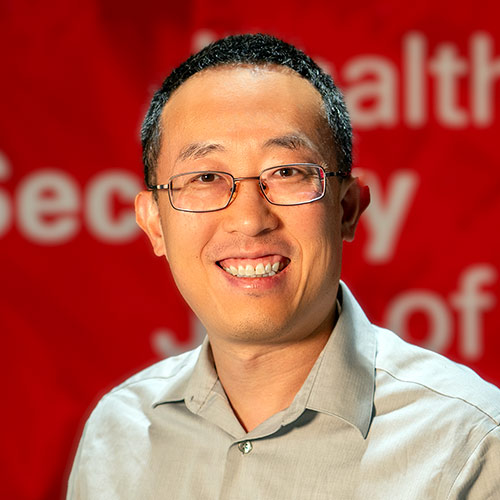
Renran Tian researches human-centered computing, cognitive AI and intelligent system design. He explores how AI can improve decision-making, strengthen interactions with automated systems and build trust in AI applications.
By combining cognitive psychology, ergonomic design and AI, he models human behavior and predicts decisions in changing environments. His work focuses on human-AI interactions in automated driving. He develops AI models that predict pedestrian intentions, increase vehicle awareness and improve driver assistance systems.
He also integrates deep learning, computer vision and multimodal sensing to advance AI-powered human sensing and intent recognition. His research applies to emergency medical response, nursing training and engineering education, ensuring AI enhances human abilities.
Discover more about Tian’s ResearchXu Xu

Xu Xu specializes in AI-driven human activity recognition for intelligent workplaces. His research combines machine learning, computer vision and biomechanical modeling to analyze human movement and posture across various occupational settings.
He uses AI-powered human-robot interaction to improve workplace safety, prevent injuries and boost productivity. His work also focuses on smart ergonomics and human factors, leveraging ubiquitous and wearable sensing technologies.
These innovations ensure that AI supports both worker well-being and system efficiency in rapidly evolving, dynamic work environments.
Discover more about Xu’s Research