
Past Healthcare Systems Engineering Specialization Projects
Past Healthcare Systems Engineering Projects
Last Updated: 04/28/2025 | All information is accurate and still up-to-date
Each academic year, you can partner with us through our Healthcare Systems Engineering Specialization Program. In this program, you work directly with student teams on real-world projects. You gain fresh ideas and creative energy from future engineers through this collaboration. At the same time, students learn by solving real challenges your business faces. As a result, both you and the student team benefit from the experience. Your sponsorship helps shape the next generation of problem solvers. We truly appreciate your past support and look forward to working with you again.
2025

Atrium Health
Student Team: Grace Bartow, Nirmitee Keluskar and Maddie Powell
Atrium Health wants to make the mammography screening process faster and more efficient by finding weak points and sources of delays. Because of this, their goal is to cut turnaround times for screening results. To help, a senior design team focused on spotting operational problems and streamlining the entire process. As a result, these improvements support Atrium Health’s “Know in 24” promise, ensuring patients get their mammogram results within 24 hours.


UNC Health (Scheduling)
Student Team: Emily Bothwell, Kristine Huynh, Katie Leonard and Lydia Lloyd
UNC Hospitals wants to shorten surgery scheduling lead time and make better use of its services by improving the Operating Room (OR) Block Schedule.
To help with this, a senior design team created a Python tool that predicts lead times and service use based on changes to block assignments. With this tool, the team can make smart suggestions for dividing OR time. In addition, the tool supports ongoing improvements by helping staff adjust schedules using real data. As a result, the hospital can boost efficiency and respond better to patient needs.

UNC Rex Health (Joint Surgery)
Student Team: BumJoon Cho, Michelle Pajak, Colin Sandberg and Andrea Zamudio
UNC Hillsborough Hospital is dealing with low throughput for total joint replacement surgeries. To help, a team worked to boost operating room (OR) productivity by creating an analytics dashboard and a reliability metric. First, they built tools for the “Ortho Initiative Committee” to track key performance indicators and guide improvements. Then, using past and current data, interviews and simulation models, the team outlined exactly how much progress was needed. As a result, their work supports completing one more total knee replacement each day and highlights the main drivers behind these gains.

2024

Premier Inc.
Student Name: Natalie Root
Premier’s procedure for hiring and internal employee movement is currently subjective and lacks objective data.
Natalie designed productivity measures to create objectivity and identify key skills to increase internal movement.

UNC Health (Urology)
Student Team: Niomi Garcia, Devpradnya Kadam and Daniela Santibanez

UNC Health (Biopsy)
Student Team: Jane Bendel, Claire Bercaw and Riley Racz
The Urologic Oncology Department at UNC Health Systems conducts advanced biopsies to screen for prostate cancer. However, long wait times and inefficiencies hinder timely access to care.
The student team’s project sought to increase the yearly appointment capacity by optimizing the UNC Urology Medical Center schedule, referred to as Main Campus.

UNC Rex Health
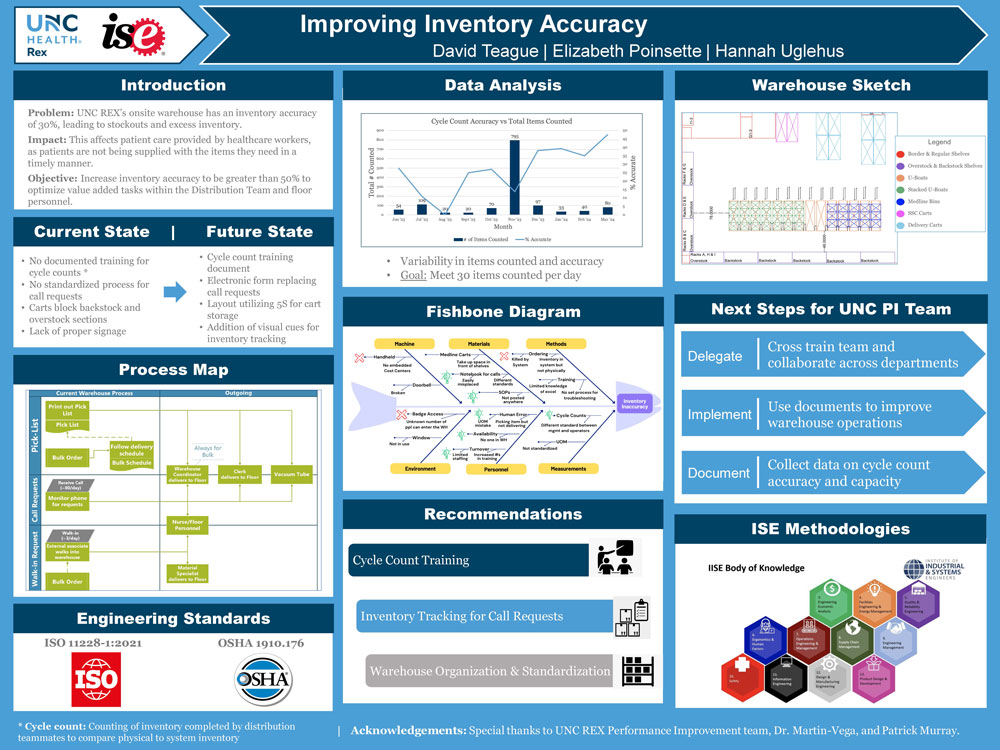
Student Team: Elizabeth Poinsette, David Teague and Hannah Uglehus
UNC Rex desired improvement in the supply chain and inventory levels within their facilities. The ISE team developed multiple recommendations to improve efficiency, including cycle count training, inventory tracking for call requests, and organization and standardization within the warehouse. These solutions directly impacted the total time lost to inventory, improved their accuracy, and reduced stockouts/excess inventory.
2023
UNC Rex Health
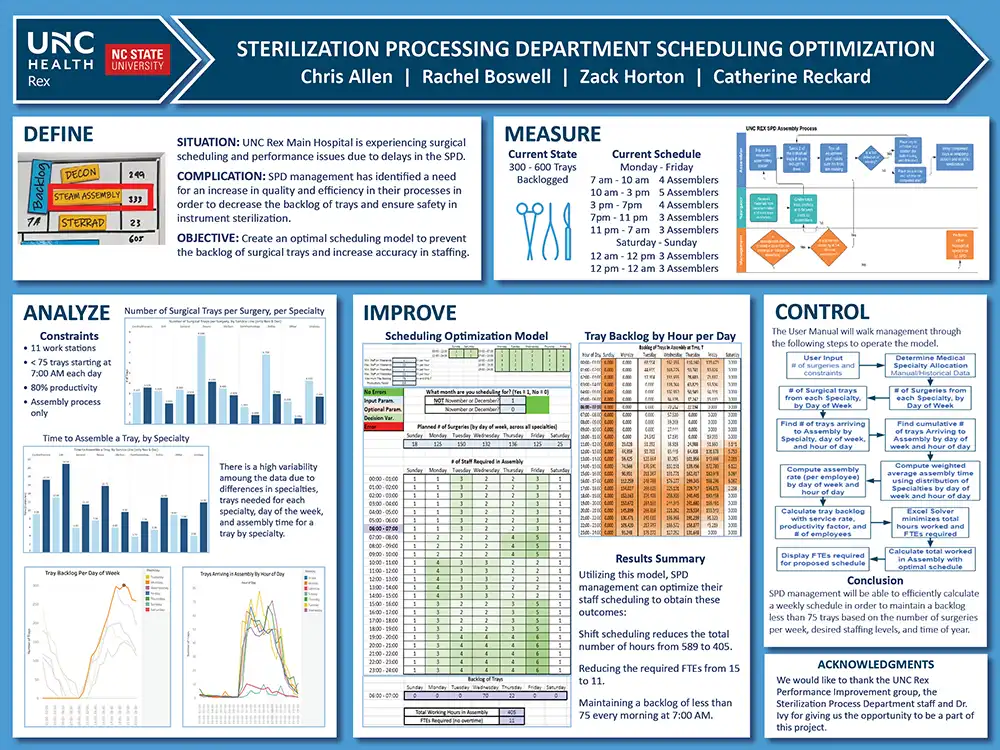
Student Team: Chris Allen, Rachel Boswell, Zach Horton and Catherine Reckard
UNC Rex’s main hospital has been experiencing surgical scheduling and performance issues due to delays in receiving the surgical tool trays. It also wants to ensure safety in instrument sterilization.
The student team created an optimized scheduling model to prevent the backlog of surgical trays and increase the accuracy in staffing.
2022
UNC Rex Health
Student Team: Amrita Malur, Lydia Underwood, Bharat Yadav and Hazal Yigit
UNC Rex has multiple facilities around NC, with the main hospital in Raleigh, NC. The growing demand for the endoscopy service line has encouraged UNC to examine the current state of its suite.
The student team created a simulation model to test different scenarios and determined that additional pre-op bays would increase the number of cases seen each day.

2021

Durham VA Dermatology
Student Team: Kylee Alons, Maddie Morello, and Jessica Williams
The Durham VA Dermatology Unit has been collecting data on biopsies performed since 2017 but does not have a method for analyzing this data or measuring their current performance. The HSECP student team analyzed the current accuracy of the Dermatology Unit’s diagnoses. They proposed methods to improve accuracy and eliminate unnecessary biopsies by identifying key accuracy influences.
UNC Rex Cancer Center
Student Team: Kaitlyn Roberts, Matt Traenkle, and John Watson
UNC Rex is building a new cancer center in the hospital that will open in January 2022. The administrative staff wanted to know if the center’s five registration bays would be sufficient to serve their current patient volume and a future increase in patient volume. Through observations, distribution fitting and simulation, the student team was able to show that the five registration bays, using the team’s schedule, kept waiting times below 10 minutes and the waiting room’s maximum capacity under 20 patients.